

 Facebook
 X
X
 Pinterest
 Copy Link
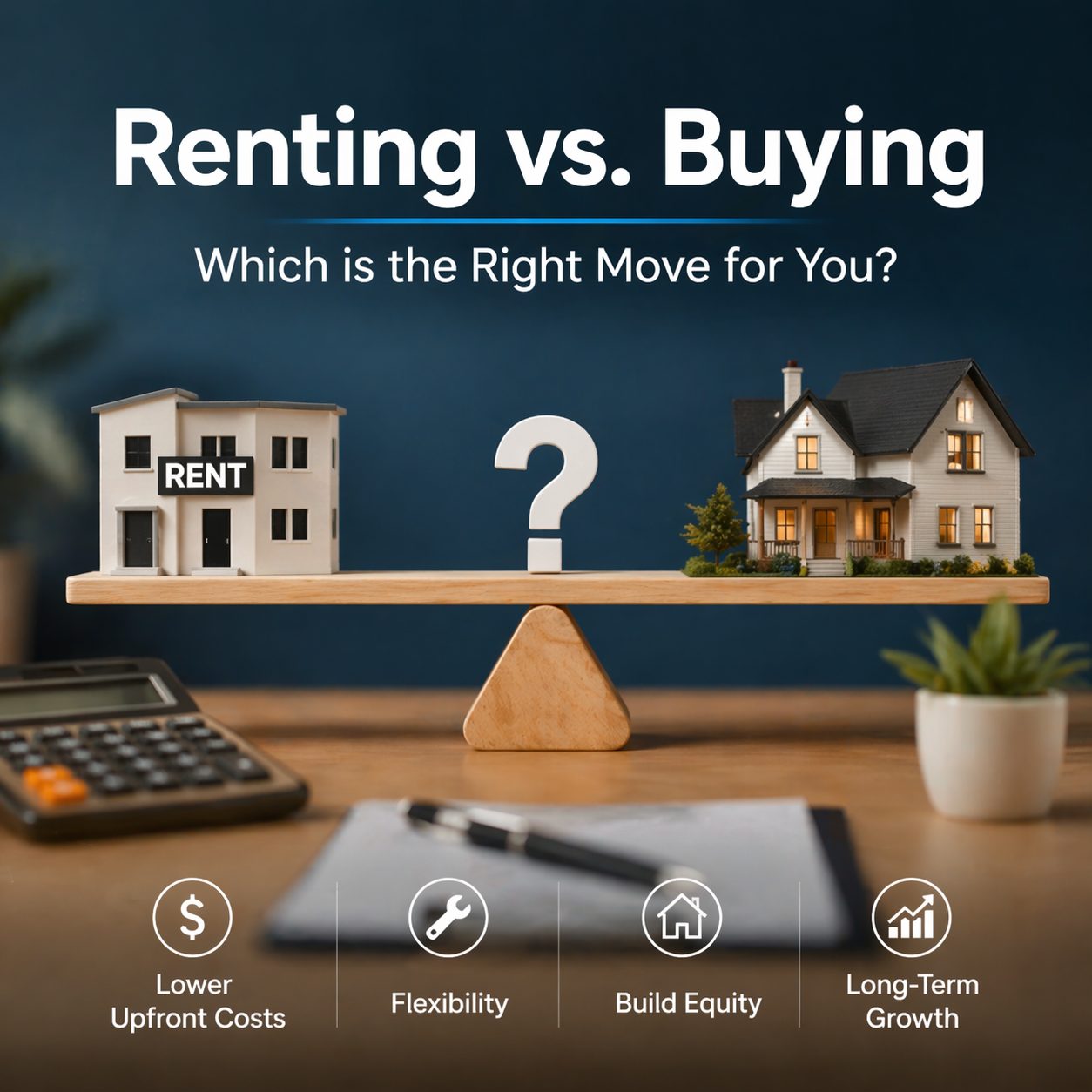
This is the question I get asked almost every single week.
“Heather, should I rent or buy?”
And I am going to be honest with you — there is no single right answer. What I can do is give you the real numbers, the tax picture, the long-term math, and the honest pros and cons of both decisions so you can make the right choice for your actual life.
Because this is one of the biggest financial decisions you will ever make. You deserve a straight answer — not a sales pitch.
Where the East Valley Market Stands in 2026
Before we compare renting and buying, you need to understand what the market actually looks like right now.
The Phoenix Metro median sale price sits at approximately $455,000 as of early 2026. In the East Valley specifically, median prices range from around $400,000 in Mesa to $665,000 in Queen Creek depending on the city and community.
Here is what renting currently costs across East Valley cities in 2026:
Mesa: Average 1-bedroom approximately $1,291 per month — 2-bedroom approximately $1,585 per month
Gilbert: Average 1-bedroom approximately $1,574 per month — house rental approximately $2,385 per month
Chandler: Average 1-bedroom approximately $2,030 per month
San Tan Valley: Average approximately $2,013 per month
And here is what buying looks like on a $450,000 home at current mortgage rates:
Current 30-year fixed rate: approximately 6.45%-6.55% as of April 2026
Monthly principal and interest: approximately $2,850-$2,900
Add property taxes: approximately $190-$225 per month
Add homeowner’s insurance: approximately $100-$150 per month
Total estimated monthly payment: approximately $3,140-$3,275 before HOA
The honest math: buying is more expensive month to month right now. That is the truth. But monthly payment is only one part of this equation — and it is not the most important part when you zoom out to 5, 10, or 20 years.
The Renter’s Reality — The Honest Pros and Cons
Advantages of Renting
Flexibility: Renting is ideal if you are new to Arizona, not sure which city fits your lifestyle, or expect a job change or relocation within the next 1-3 years. A 12-month lease gives you the ability to move without the transaction costs of selling a home.
Lower upfront cost: Renting typically requires only a security deposit and first month’s rent — usually $2,000-$5,000 to move in. Buying requires a down payment, closing costs, and cash reserves — typically $15,000-$50,000+ depending on your purchase price and loan type.
No maintenance responsibility: When the AC breaks in July — and in Arizona, if it breaks in July, that is a genuine emergency — your landlord pays for it. As a renter, you have no surprise repair bills, no roof replacement, no water heater costs.
Lower monthly payment right now: At current East Valley rent levels, a 2-bedroom apartment or smaller home is often $400-$900 per month less than owning a comparable property. That gap is real.
The Honest Disadvantages of Renting
Your payment builds zero wealth: Every rent check you write disappears forever. You are paying your landlord’s mortgage, building your landlord’s equity, and growing your landlord’s net worth — not your own. After 5 years of renting at $2,000 per month, you have paid $120,000 and own nothing.
Rent increases are not in your control: Arizona law does not cap rent increases. Your landlord can raise your rent at lease renewal to whatever the market will bear. East Valley rents have increased significantly over the past 5 years and while they have moderated recently, there is no protection against future increases.
No stability or permanence: Your landlord can choose not to renew your lease. They can sell the property. They can raise rent beyond what you can afford. Your housing situation is always subject to someone else’s decisions.
No personalization: You cannot paint, renovate, or make the space truly yours without landlord permission. You live in someone else’s home on their terms.
The Buyer’s Reality — The Honest Pros and Cons
Advantages of Buying
You build equity every single month: This is the foundational difference between renting and buying. When you make a mortgage payment, a portion of it reduces your loan balance — that is equity building in your pocket, not your landlord’s. Over time, as your loan balance decreases and the value of your home potentially increases, you are building real, tangible wealth.
Here is a real example:
You purchase a $450,000 home in Mesa in 2026 with 5% down ($22,500).
Your loan balance: $427,500
By month 60 (year 5), your loan balance has decreased to approximately $400,000 through principal paydown alone.
If the home appreciates modestly at 3% annually — historically conservative for the East Valley — your home is now worth approximately $521,000.
Your equity after 5 years: approximately $121,000
Compare that to renting for 5 years at $2,000 per month: $120,000 spent. $0 equity. $0 net worth built.
Your payment is locked in: With a 30-year fixed rate mortgage, your principal and interest payment never changes. Your landlord cannot raise it. Inflation cannot raise it. In 10 years when rents have continued to increase, your mortgage payment is the same as it was on day one. That payment certainty has enormous long-term value.
Appreciation — your home grows in value: East Valley home values have shown strong long-term appreciation. Gilbert homes appreciated approximately 79% from 2019 to 2026. Mesa has consistently outperformed national averages. Queen Creek went from a median of approximately $290,000 in 2019 to $640,000-$665,000 in 2026.
Homeownership allows you to participate in that appreciation. Renting does not.
Home equity is a financial tool: Equity is not money sitting locked in a wall. It can be accessed through a home equity line of credit or home equity loan for home improvements, education, or other major expenses — at interest rates far lower than personal loans or credit cards. Homeowners regularly use their equity as a financial foundation in ways renters simply cannot.
Stability and permanence: Nobody can evict you from your own home as long as you make your payments. Nobody can raise your housing payment without notice. You can paint, renovate, plant a garden, get any dog you want, and make the space truly yours.
The Honest Disadvantages of Buying
Higher upfront costs: Closing costs in Arizona typically run 2%-5% of the purchase price for buyers — on a $450,000 home that is $9,000-$22,500 at closing in addition to your down payment. This is a real barrier that requires planning and saving.
Higher monthly payment — right now: At current rates the monthly cost of owning typically exceeds renting in the East Valley by several hundred dollars. That gap matters for monthly cash flow.
Maintenance is your responsibility: Budget approximately 1% of your home’s value annually for maintenance and repairs. On a $450,000 home that is $4,500 per year — roughly $375 per month — that should be part of your budget calculation.
You need to stay for at least 3-5 years: Buying makes financial sense when you plan to stay. Transaction costs on both the purchase and eventual sale typically run 8%-10% of the home’s value. If you buy and sell within 2 years, you likely will not recoup those costs even with modest appreciation.
The Real Numbers — A Side by Side Five Year Comparison
Let us do the math honestly on the East Valley in 2026.
Renting Scenario
Rent: $2,000 per month for a 2-bedroom apartment
Annual rent increases: 3% per year (modest estimate)
5-year total payments: approximately $127,400
Equity built: $0
Net worth growth from housing: $0
Buying Scenario
Purchase price: $450,000 home in Mesa
Down payment: 5% — $22,500
Closing costs: approximately $9,000-$13,500
Monthly payment (PITI): approximately $3,200 including taxes and insurance
5-year total payments: approximately $192,000
Equity built through principal paydown: approximately $27,500
Home value appreciation at 3% annually: approximately $71,500
Total equity after 5 years: approximately $99,000 (down payment + principal paydown + appreciation)
Net worth growth from housing: approximately $99,000
The buyer spent approximately $64,600 more over 5 years in monthly payments. The buyer gained approximately $99,000 in net worth. Net advantage of buying over 5 years: approximately $34,400 — plus they still own an asset worth $521,000.
This math becomes more dramatic the longer you hold. Over 10 years, 15 years, 20 years — the wealth gap between homeowners and renters compounds significantly. According to the National Association of Realtors, the median homeowner net worth is approximately 40 times the median renter net worth — a gap driven primarily by home equity accumulation.
The Tax Advantages of Homeownership — Real Numbers for 2026
This is one of the most misunderstood parts of the rent vs. buy conversation. Homeowners receive significant tax benefits that renters do not. Here is what is available in 2026 following recent tax law changes.
Mortgage Interest Deduction
Homeowners who itemize their federal tax return can deduct interest paid on mortgage debt up to $750,000. This deduction applies to your primary mortgage. In the early years of a mortgage when interest makes up the largest portion of your payment, this deduction can be substantial.
Example: On a $427,500 mortgage at 6.5%, you pay approximately $27,600 in interest in year one. If you are in the 22% federal tax bracket, deducting this interest saves you approximately $6,072 in federal taxes.
Important note: The 2026 standard deduction is $16,100 for single filers and $32,200 for married filing jointly. Your total itemized deductions need to exceed these amounts for the mortgage interest deduction to provide additional benefit. Most homeowners with large new mortgages and property taxes do exceed these thresholds.
Property Tax Deduction
Under the State and Local Tax deduction — known as SALT — homeowners can now deduct up to $40,400 in state and local taxes including property taxes in 2026. This is a significant increase from the previous $10,000 cap under the One Big Beautiful Bill Act.
Arizona’s property taxes are among the lowest in the country — averaging 0.46%-0.65% of home value. On a $450,000 home your annual property tax runs approximately $2,070-$2,925 — a meaningful deduction when combined with state income taxes.
PMI Deduction — Restored in 2026
If you put less than 20% down and pay Private Mortgage Insurance, that PMI is now permanently deductible as mortgage interest starting in the 2026 tax year — a benefit that was previously expired. This is particularly helpful for first-time buyers with smaller down payments.
Capital Gains Exclusion — The Big One
This is one of the most powerful tax benefits in the entire tax code and renters get zero access to it.
When you sell your primary residence, you can exclude up to $250,000 in profit from federal capital gains taxes if you are single — and up to $500,000 if you are married filing jointly — as long as you have lived in the home for at least 2 of the past 5 years.
Example: You buy a home for $450,000. You sell it 7 years later for $650,000. Your profit is $200,000. As a single filer, you owe zero federal capital gains tax on that $200,000 because it is below the $250,000 exclusion. As a married couple, you would still owe zero. That is a tax-free gain that would be worth approximately $30,000-$45,000 in taxes if it were any other type of investment.
Home Equity Loan Interest Deduction
If you take out a home equity loan or line of credit and use the funds to buy, build, or substantially improve your home, the interest may be deductible. This makes home equity financing for renovations significantly more cost-effective than unsecured borrowing.
ALWAYS CONSULT A TAX PROFESSIONAL for advice specific to your situation. I am sharing these benefits as informational context — not tax advice.
Arizona Programs That Make Buying More Accessible
One of the biggest myths I hear is that you need a 20% down payment to buy a home. You absolutely do not.
Home Plus Arizona — The State Program
The Arizona Industrial Development Authority runs the Home Plus program — the only state-run, statewide down payment assistance program in Arizona. It is available in every county, city, and zip code in the state.
What it offers: 30-year fixed rate mortgage. Up to 4% in down payment and closing cost assistance — 5% for active military and veterans. Income limit: $155,386 annually (as of April 2026). Credit score requirement: 620 minimum. Does not deplete funding — available year round.
Over 32,000 Arizona homebuyers have used Home Plus.
Home in Five Advantage — Maricopa County
For buyers in Maricopa County — which covers Gilbert, Chandler, Mesa, Queen Creek, and most of the East Valley — the Home in Five Advantage program offers: Up to 6% in down payment assistance as an interest-free, forgivable second mortgage. Additional 1% for elementary school teachers, first responders, military/veterans, or buyers earning $49,500 or less.
FHA Loans — 3.5% Down
FHA loans allow qualified buyers to purchase with as little as 3.5% down with a minimum credit score of 580. On a $450,000 home, that is a $15,750 down payment — a real pathway for buyers who have not accumulated a large savings.
Conventional Loans With 3% Down
Fannie Mae and Freddie Mac both offer conventional loan programs requiring as little as 3% down for qualified buyers.
VA Loans — 0% Down
If you are a veteran, active military, or qualifying spouse — VA loans require no down payment, no PMI, and offer competitive interest rates. This is one of the most powerful homebuying benefits available.
When Renting Makes More Sense
I want to be balanced here because renting is the right choice for some people in some situations.
Renting makes more sense if: You are new to Arizona and not yet sure which city fits your lifestyle. You expect to relocate within the next 1-3 years for work or personal reasons. You are in the middle of a major life transition — divorce, career change, financial restructuring. Your credit score or financial situation is not yet ready for a home purchase. You are still exploring neighborhoods and do not want to commit before you are confident.
If any of these describe you — renting while you prepare and plan is not a failure. It is smart. Just make sure you are using that rental period intentionally — building savings, improving credit, getting educated about the market — not just paying rent indefinitely.
When Buying Makes More Sense
Buying makes more sense if: You plan to stay in the East Valley for at least 3-5 years. You have stable employment and reliable income. You have savings for a down payment and closing costs — or qualify for down payment assistance. Your credit score is 620 or above — ideally 680+. You are tired of rent increases and want payment certainty. You want to begin building wealth through real estate rather than funding someone else’s.
The Honest Bottom Line
Every dollar you pay in rent is gone forever. Every dollar that goes toward your mortgage principal is yours — building in the form of equity, growing with your home’s appreciation, and available through refinancing or sale when you need it.
That does not mean buying is right for everyone right now. But it does mean that if you are financially ready and planning to stay, buying in the East Valley in 2026 — in a buyer’s market with more inventory and negotiating power than we have seen since 2017 — is one of the best opportunities available to build long-term financial stability.
I am not here to sell you a home. I am here to help you make the right decision. If that is renting for another year while you save and prepare — I will tell you that. If the numbers say buying makes sense for your situation — I will show you exactly why.
Let’s run your numbers together. No pressure. Just an honest conversation.
Heather Seegmiller
Licensed Arizona Realtor
Better Homes and Gardens Real Estate S.J. Fowler
(480) 316-2667 | heather.az.properties@gmail.com | heatherarizonarealtor.com
License SA715388000 AZ


